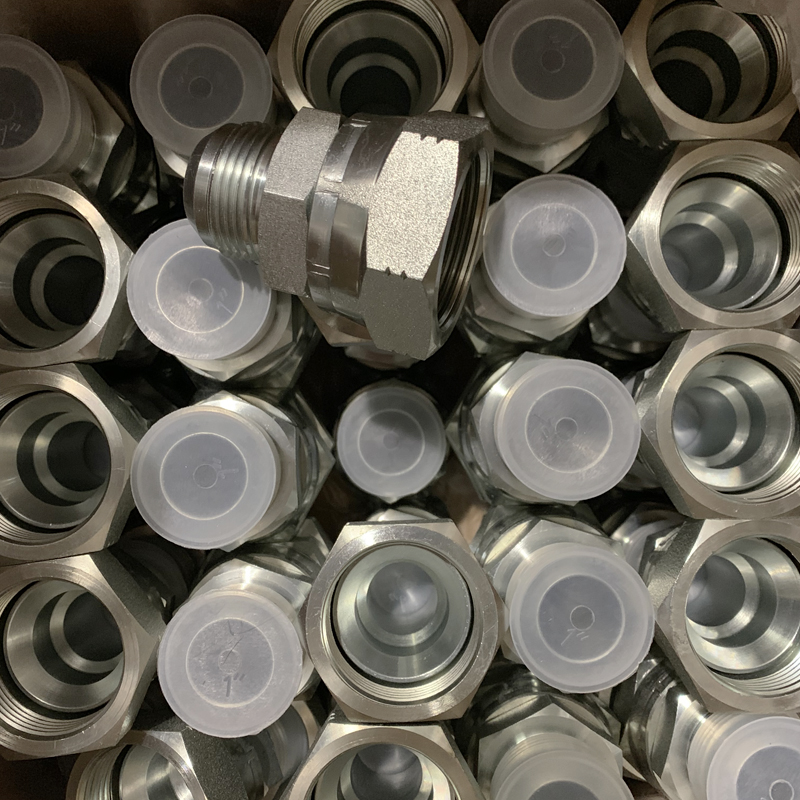
Most crews order 316L because "stainless doesn't rust." On most industrial hydraulic circuits that choice buys thread galling, chloride cracking and cost instead of service life. The coated C45 fitting usually outlasts the stainless one.
The stainless vs carbon steel hydraulic fittings question is a materials question, not a catalog question. This article gives the short answer first, then shows what the shop floor sees on both materials before they reach your bench: how each one galls, how each one fails in wet service, what the steel grade does to the pressure rating, and where each production route actually spends your money.
The Short Answer: Coated C45 Wins Most Industrial Circuits
Take the position up front. If the fitting lives indoors on a fixed power unit, a press, an injection machine or a test bench, forged C45 carbon steel with a zinc or zinc-nickel coating is the stronger, cheaper and easier-to-service answer. Stainless 316L earns its premium in exactly three situations: daily caustic washdown, marine splash zones, and chemical vapor. Everything else is a habit, not a decision — and it is the default Ruihua Hardware quotes for indoor circuits.
Three failure modes sit behind that position. Two of them — thread galling and chloride stress cracking — belong to stainless. The third, coating damage, belongs to carbon steel and is manageable if the coating is chosen and inspected deliberately. A crew that understands all three stops defaulting to the stainless column on the quote sheet.
What Galling Does to a Torque Wrench
Austenitic stainless protects itself with a thin, self-repairing oxide film. That film is the reason stainless does not rust — and the reason its threads seize. Under the high contact pressure on thread flanks, the film ruptures, and the bare metal underneath cold-welds to the mating thread. The nut stops turning at a fraction of the specified torque. Keep pulling and the hex rounds off or the fitting body twists in the tube fitting behind it.
Pairing a stainless nut with a stainless body is the worst case, because both flanks are the same hard-to-lubricate material. Annealed 316L arrives around 150–180 HB; C45 in the condition used for forged adapters runs harder. Softer flanks deform under load, which multiplies the contact area and feeds the galling. Every technician who has cut a seized 316L adapter off a manifold with a saw knows the sequence: no warning, no thread damage you can see, just a joint that refused to turn.
The same joint in zinc-plated C45 turns, torques and re-torques cleanly, because the plated surface with an oil film does not cold-weld. If the specification really forces stainless onto the line, three mitigations exist: anti-seize compound on the threads, a hardness mismatch between the nut and the body, and a slow final half-turn. All three cost the assembler time on every cycle. Coated carbon steel costs none.
Chloride Stress Cracking: The Failure 316L Keeps
The second failure mode is the one nobody orders. Austenitic 316L is susceptible to chloride stress corrosion cracking above roughly 60 °C in chloride-bearing environments — hot washdown lines running chlorinated sanitizers, coastal plants, equipment near brine. The crack grows through the boss with almost no visible warning and releases at working pressure.
Compare the failure modes honestly. A coated carbon steel fitting that loses its coating fails visibly: a rust bloom appears at the scratch, the joint still holds, and the next inspection catches it. A cracked 316L fitting fails suddenly. For a maintenance planner, "visible and slow" beats "invisible and sudden" every time, because one can be scheduled and the other can only be survived.
There is also a reversed assumption worth correcting. A stainless adapter threaded into a carbon steel manifold or block forms a galvanic couple. In wet service the less noble surface — the carbon steel around the port — corrodes faster, not slower. The stainless fitting can outlive the hole it sits in.
Strength: What the Steel Grade Does to the Pressure Rating
Geometry does not carry a pressure rating; the material and its condition do. Annealed 316L bar carries a minimum tensile strength around 485 MPa. C45 carbon steel, normalized or quenched and tempered the way forged hydraulic adapters are made, runs well above that. Two fittings with identical threads and identical cones therefore do not share a pressure table when the grade changes.
Concretely: the 1EN straight adapter is machined from forged C45 (AISI 1045) and rated up to 5000 PSI working pressure at the small end of its range, M14×1.5 down to 1/8 inch NPT, stepping down toward 2500–3000 PSI at the large sizes. A 316L version of the same geometry does not inherit that table. It has to be re-rated, re-tested and re-documented — which is exactly what the "stainless on request" quote column pays for.
What Each Material Goes Through Before It Ships
The production routes explain most of the price gap. The carbon steel path looks like this: C45 bar is forged into the adapter blank, CNC lines cut the threads and the cone seats with in-process gauging, the batch runs through the zinc or zinc-nickel plating line with trivalent passivation, and every piece passes a pressure test before thread protect caps go on. The plating line is where the corrosion budget gets spent, and it is cheap per part because it runs in racks, not per piece.
The 316L path runs slower. Austenitic stainless work-hardens under the cutting tool, so speeds drop, tool life shortens, and cycle time per part climbs. There is no plating line to pay for, but the raw stock itself costs several times what C45 bar costs. That is why Ruihua Hardware quotes the stainless version on request rather than stocking it: the demand is real but narrow, and carrying it as a standard line would price every indoor customer for a capability they never use.
When 316L Is the Right Answer
None of this makes stainless a bad material. It makes it a specialized one. Order 316L when the coating has no chance of surviving:
Daily caustic washdown. Food and pharmaceutical lines use sanitizers that strip zinc plating in weeks. A scratched coating on a washdown line is a corrosion seed, and there is no practical way to re-coat a fitting on the machine.
Marine splash zones. Salt fog every day, plus abrasion from handling, exhausts any coating system. 316L with no coating to lose is the honest answer.
Chemical vapor. Fittings mounted near tanks holding acids, chlorides or solvents live in an atmosphere the plating was never designed for.
Note what the three cases share: in all of them the environment attacks the coating, not the steel. Where the coating survives, carbon steel survives with it. The earlier article on zinc-nickel versus zinc plating covers how far a good coating extends that boundary — zinc-nickel at 8–12 μm holds no red rust through 240 hours of ASTM B117, which covers weather, road salt and most outdoor installed locations.
The Bench Rule: Decide in Ten Seconds
Run three questions in order and the material picks itself:
Where does the fitting live? Indoors on a fixed machine, coating intact — coated C45. Washed with caustic, splashed with salt, or standing in chemical vapor — 316L.
Who torques it, and how often? Repeated rework cycles with hand tools favor plated carbon steel. If stainless is unavoidable, write anti-seize and the slow final turn into the assembly instructions, or the crew will round hexes until the schedule slips.
What carries the pressure? If the circuit runs near the top of the fitting's rating, the steel grade is not negotiable. Re-rate the stainless option before it goes on the drawing, not after the test bench.
What Ruihua Hardware Ships in Each Material
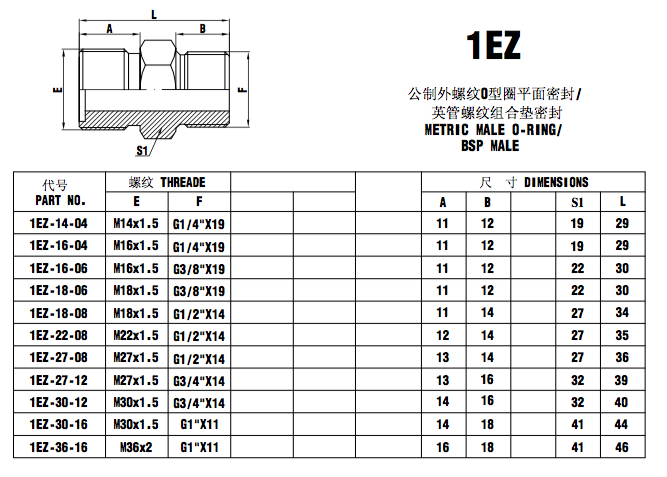
The reference part for the carbon steel side is the 1EN metric male O-ring / NPT male straight adapter: forged C45 (AISI 1045) body, color zinc or white zinc plating with trivalent passivation passing 96 hours of ASTM B117, metric O-ring boss from M14×1.5 to M42×2 on one end and NPT male from 1/8 to 1-1/4 inch on the other, working pressure up to 5000 PSI by size, −40 to +120 °C with the standard NBR O-ring, thread protect caps on both threads, 100% pressure tested, standard sizes shipping in 7 to 15 days. The 1EZ metric O-ring / BSP male straight carries the same material logic into BSP plumbing.
For the three environments where coating cannot survive, the same families are available in stainless 316 on request, quoted with the thread pairs and the re-rated pressure figures written out rather than inherited. Ask for the environment in one line and the quote comes back with the material decision already reasoned.
What Assemblers Ask About Stainless vs Carbon Steel
Is 316L stainless weaker than carbon steel for hydraulic fittings?
In the annealed condition that bar stock arrives in, yes. 316L sits around 485 MPa minimum tensile; forged C45 runs above that. Identical geometry does not mean identical pressure rating, so a stainless version never inherits the carbon steel table.
Why do stainless fitting threads gall and seize?
The oxide film that keeps stainless rust-free ruptures under thread-flank pressure and cold-welds to the mating surface. Same-material pairs are the worst case. Anti-seize, a hardness mismatch and a slow final turn reduce it; plated carbon steel with an oil film does not cold-weld at all.
When is stainless actually the right choice?
Daily caustic washdown, marine splash zones, chemical vapor. In all three the environment destroys coatings, so the fitting that needs no coating wins. Everywhere else, a verified coating wins on strength, torque behavior and cost.
Does a coated carbon steel fitting match stainless outdoors?
Zinc-nickel at 8–12 μm holds no red rust through 240 hours of ASTM B117, which covers most outdoor duty. The weak point is mechanical — a wrench on the flats cuts the coating. Inspect the coating at receiving and the stainless default loses its reason.
Can I swap a coated fitting for stainless on the same port?
It threads on, but the pressure ceiling, the torque behavior and the galvanic pairing all change. In wet service, stainless in a carbon steel manifold accelerates corrosion around the port. Confirm rating and environment with the supplier first — Ruihua Hardware re-checks both before quoting a material swap.
Send the Environment With the RFQ
Next time the material column comes up, put the working environment in one line before the price discussion starts: indoor or outdoor, washdown or dry, salt exposure, torque cycles. Send it to Ruihua Hardware through the contact page and the quote comes back with the material reasoned, the coating specified and the pressure figures re-checked for the grade proposed. The full fitting range sits on the products page. Stainless is a material for environments, not a badge of quality — order it where the environment demands it, and spend the difference where it buys service life.
Lynn Liu is a Senior Foreign Trade Specialist at Ruihua Hardware with over 10 years of experience in hydraulic fittings export. She helps global buyers source reliable, cost-effective, and application-ready hydraulic connection solutions from China.