Two quotes land on the same desk. Both say DIN 2353, light series, 12 mm tube, 315 bar, zinc-nickel. One is eighteen percent cheaper. The buyer approves it, the first article measures to drawing, and the fittings go onto a machine that runs for eleven months before one joint starts to weep. Nothing was out of tolerance. The problem is smaller and harder to argue with: the standard told the supplier the thread and the 24 degree cone. It never told them whose cutting ring goes inside the bag.
So here is the short answer. DIN 2353 fittings interchange at the interface and nowhere else. Thread, cone angle, tube outside diameter and series dimensions are fixed, which is why any competent factory can make a part that threads onto your tube end. The joint is a different matter. The cutting ring, the nut that drives it, the steel behind it and the paperwork that proves the lot are all left to the supplier. That gap is where second-sourcing goes wrong, and a purchase order either closes it or ignores it.
This article answers the questions sourcing teams put to us, in the order they come up: what the marking actually guarantees, whether you can keep your existing nuts and rings, why two "metric bulkhead" quotes are not the same part, where a pressure rating stops being comparable, and what has to sit on the RFQ before a new source counts as equal.
What Does a DIN 2353 Marking Actually Guarantee?
The marking on the part is a dimensional claim, not a performance claim. When a fitting carries DIN 2353 and a series letter, the supplier is telling you it matches a drawing. That is all.
The standard fixes a short list. The 24 degree cone angle. The thread that pairs with each tube outside diameter, so 6 mm takes M12x1.5, 8 mm takes M14x1.5, 10 mm takes M16x1.5 and 12 mm takes M18x1.5 in light series. The series dimensions, with light series rated to 315 bar and heavy series to 630 bar. The wall thickness the tube must carry.
It leaves a longer list open. The cutting ring's own geometry, including whether it has one cutting edge or two, how hard it is and how the lead-in is chamfered. The internal profile of the nut that pushes the ring forward. The plating thickness inside its permitted range. The steel grade, since C45 carbon steel and 316L stainless are both legitimate choices and neither is the default. Whether the lot was proof tested or only measured. And which documents travel with the box.
Read that list again and the conclusion is uncomfortable. DIN 2353 behaves like a port standard far more than a joint standard. Two factories can both comply with it and still ship joints that behave differently after a thousand pressure cycles.
Can I Buy From a Second Supplier and Keep My Existing Nuts and Ferrules?
No, not as a habit. The nut, the ring and the body work as one system, and the standard only draws the envelope around that system.
The cutting ring is the reason. At first assembly the ring bites into the tube surface and its rear face seats against the cone in the body. That is a permanent set. Take the joint apart and the ring has already been formed against one tube and one seat. Put it on a different body and it has to bite a second time. A ring that has work-hardened once does not cut a clean second groove, and the seal you get is luck rather than design.
The nut matters for the same reason in the other direction. The nut is the tool that forms the ring. Its internal cone drives the ring's rear face forward by a set distance, and small differences in that profile change how far the ring travels and where it finally seats. A nut from one factory on a ring from another is two halves of a press tool made to different drawings.
The sourcing rule that follows is simple. Put nut, ring and body on the purchase order as one line item with one part number, not as three lines that happen to arrive together. If a second source has to come in, bring it in as a complete set and re-approve the assembly on your own tube with your own torque value. There is one legitimate exception: if the body is the only part you ran out of, second-source the body alone and keep the original nuts and rings, provided the cone seat checks out at the same angle and depth.
Two Quotes Say "Metric Bulkhead". Are They the Same Part?
No, and this is the cross-reference error we see most often. Both parts pass a line through a panel. Both are bulkhead fittings. Both are metric. They do not do the same job.
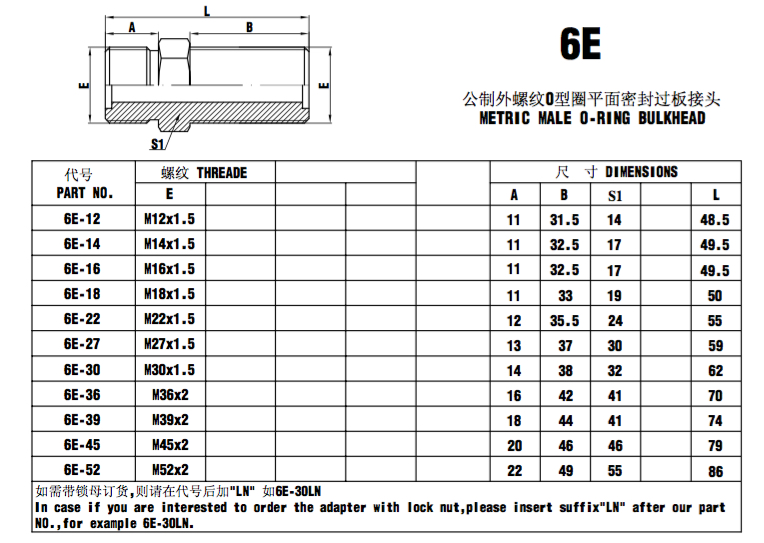
The 6C on the Ruihua Hardware line is a metric male 24 degree cone bulkhead in light series. It gives you a tube connection on both sides of the panel, and both ends seal on a cone. The 6E is a metric male O-ring bulkhead. It seals with an O-ring that sits in a counterbored port. Different port preparation, different seal, different bore through the panel.
If your drawing calls a 24 degree cone bulkhead and the new supplier ships an O-ring bulkhead because both sat under "metric bulkhead" in a cross-reference table, you get a part that fits the hole and not the circuit. It will install. It may even hold at low pressure. The port it lands in is simply not the port it was designed for.
Cross-reference on four fields, never on the name: thread, seal type, tube outside diameter, series. If a supplier cannot fill all four for the part they are offering against your part number, the cross-reference is not finished. They can review the full range on the products page.
Same M Thread, Different Seal — Where Does 2BC/2BD Fit?
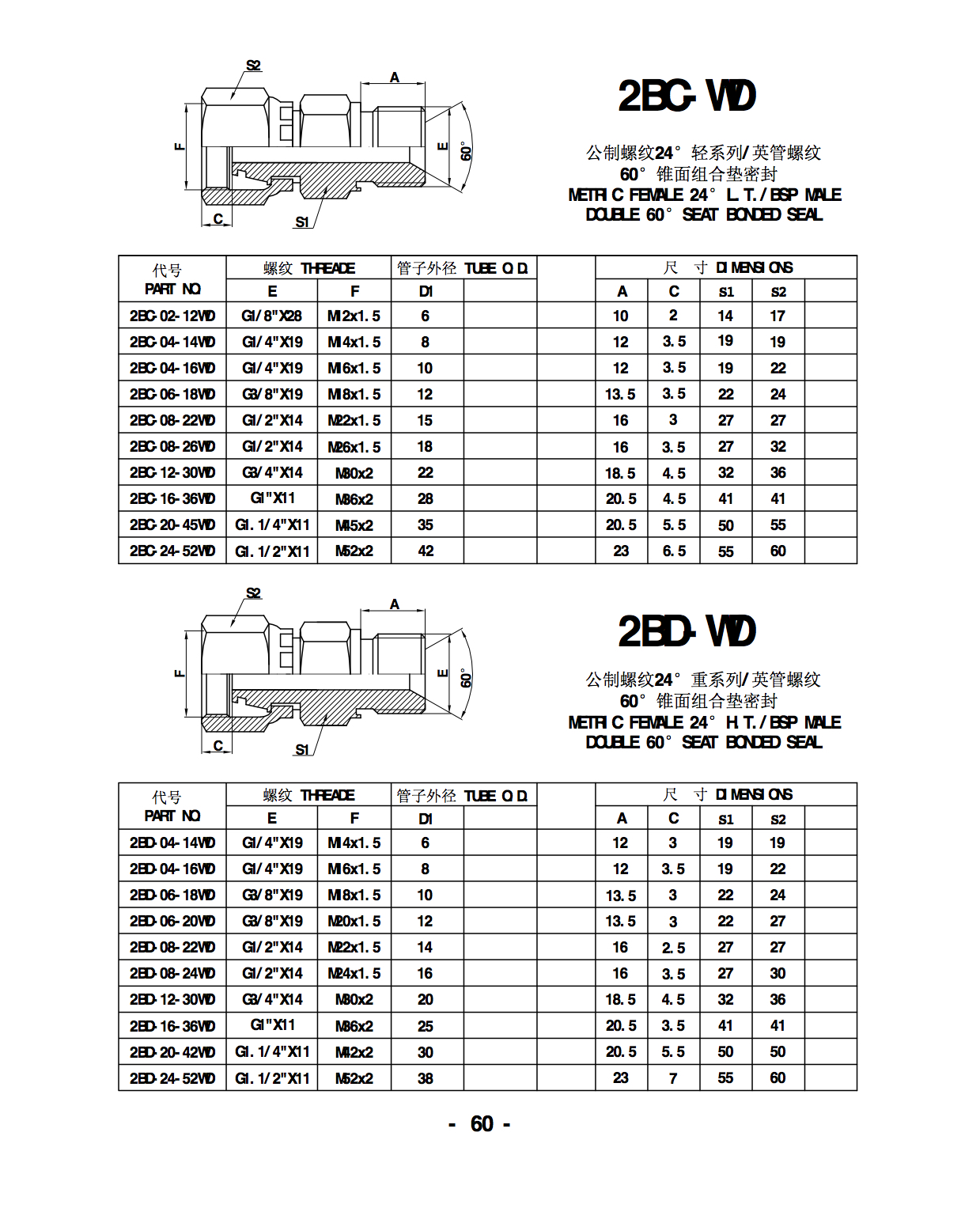
The 2BC and 2BD in the Ruihua Hardware range are metric and BSP thread studs with a bonded seal. They seal on the flat face of a spot-faced port, using a captive elastomer washer trapped under the hex. In several sizes the thread is the same M thread you would find on a 24 degree cone stud.
That shared thread is the trap. Thread a bonded seal stud into a cone port and it runs in smoothly and feels correct. It will not seal, because the washer needs a flat machined face to crush against, and a cone port offers a cone where the washer expects a face. The reverse is just as true: a 24 degree cone stud in a spot-faced bonded seal port has no cone to seat on, so the metal-to-metal contact that does the sealing never happens.
This is the most expensive kind of wrong part because it installs without complaint. Nothing cross-threads. Nothing bottoms out early. It fails at pressure, or on the first thermal cycle, or on the test bench at the customer's plant, which is the worst place to find out. You can check the stud range on the 2BC 2BD bonded seal page.
Both Quotes Say 315 Bar. Is the Rating the Same?
Not necessarily, because 315 bar is a series figure rather than a test result. Light series is rated to 315 bar and heavy series to 630 bar, and both numbers assume the correct tube wall and a correctly assembled joint. Change either and the ceiling moves.
Three things shift it on a real circuit. Tube wall thickness at the same outside diameter, since a thinner wall flexes more under pressure spikes and works the ring loose. Material, because C45 and 316L do not behave the same under cycling even when both meet the dimensional drawing. And the test regime, because a lot that was proof tested is not the same article as a lot that was measured and packed. If the series question itself is still open, the earlier article on DIN 2353 light versus heavy series walks through where the standard draws that line.
So ask for the basis, not the number. Proof test pressure and the sample rate per lot, or a burst test report. For surface protection, ask for the report rather than the phrase: 8 to 12 microns of zinc-nickel with 240 hours of neutral salt spray to ASTM B117 is a specification, while "zinc nickel" on its own is only a description.
What Has to Be on the RFQ Before a Second Source Counts as Equivalent?
Seven lines. Every one of them exists because a buyer has been caught without it.
Standard and series. Cite DIN 2353 and ISO 8434-1 together, then name the series: light, 24 degree cone, cutting ring. Two standard numbers stop a supplier from choosing a series on your behalf.
Tube, not just fitting. Outside diameter and wall, for example 12 x 1.5 mm, plus material and temper.
Thread and seal, written separately. M18x1.5 and 24 degree cone are two facts. "Metric" is neither of them.
Surface treatment with numbers. Zinc-nickel at 8 to 12 microns, 240 hours ASTM B117, or plain zinc if that is what the drawing actually says.
Documents. EN 10204 3.1 per heat number, a dimensional report, and the marking you expect to see on the part.
Delivered form. Nut, ring and body supplied as one matched set from one lot, with no mixed bins in the carton.
An approval step. First article assembled on your tube, torqued with your wrench, pressure cycled, signed off before the purchase order releases.
Line seven is the one that gets dropped when a project is late. It is also the only line that tests the joint rather than the drawing.
Where Does the 18% Cheaper Quote Show Up Later?
Rarely on the invoice, and usually somewhere in operations. Four places to look before you sign.
Certificates are charged per lot. A 3.1 certificate covers a heat number, not a piece. Consolidate twelve sizes into one production lot and the certificate cost spreads across the whole run. Split the same order into twelve purchase orders and you buy twelve lots, twelve test rounds and twelve sets of paperwork, which is often where the eighteen percent went.
Minimum order quantity per size, not per order. A twelve-size order with a per-size minimum is a twelve-size commitment. Ask which way the minimum is counted before you compare total value.
Lead time against a line stop. Stock sizes and made-to-order sizes are different products at different prices. A cheaper quote on a six-week lead is not cheaper if the machine is waiting, and the delta is easy to calculate once you know your own downtime cost per day.
Rework and claims. One weeping joint on a commissioned machine costs more than the price gap on a full size run: drained oil, a new tube, a new ring, crane access and a crew day. And without lot marking and a 3.1 certificate you cannot trace a bad batch back to a heat number, so you absorb the whole lot instead of one melt.
What Does Ruihua Hardware Put in the Box With Each Lot?
At Ruihua Hardware, the deliverable is a matched set rather than a bag of parts. Nut, cutting ring and body are produced and packed as one system per size, with thread protect caps, then carton and pallet. Every piece is checked before it leaves, and standard sizes are quoted at 7 to 15 days.
The material is C45 carbon steel as standard, with 316L available when the circuit or the washdown demands it. Surface is zinc-nickel at 8 to 12 microns, verified to 240 hours of ASTM B117, or plain zinc for indoor work. Heavy series parts are proof tested before shipment. The marking on the part carries the series and the size, so a storeman can tell a light body from a heavy one without a caliper.
The O-ring bulkhead above is a good example of why the packing matters. You can see the specification on the 6E O-ring bulkhead page, including the thread protect cap, which is not decoration. A dinged thread on a bulkhead stud is a rejected part at goods-in, and that argument costs more than the cap.
What Do Buyers Ask Before the First Order?
Can I reuse a DIN 2353 cutting ring after I take a joint apart?
Only in the same body and the same position, tightened to the same value. A ring that has been torqued has bitten the tube and seated on the cone, so it has taken a set. Move it to another body and it has to cut a second groove, which a work-hardened ring does not do cleanly. Treat the ring as a consumable and price it that way.
Do I need an EN 10204 3.1 certificate on every DIN 2353 shipment?
No. Indoor circuits on a fixed power pack usually accept a 2.2 declaration and a dimensional report. European end customers, offshore work and safety functions should carry 3.1 per heat. Decide per project and put it on the RFQ, because adding it after the order means a new lot and a new lead time.
Can a DIN 2353 fitting be adapted into a BSP port?
Yes, with an adapter, but you then own two joints instead of one. The adapter has to match DIN 2353 on one end and a G thread with the right seal on the other. Each joint has its own torque value and its own leak path, and the assembly grows longer, which is often the real reason an adapter will not fit.
What is the minimum a supplier needs to quote a DIN 2353 part?
Five fields: standard and series, tube outside diameter and wall, thread plus seal type, material and surface, and the documents required. With those five, two quotes describe the same part. Without them, you are comparing two different parts at two prices.
Is a DIN 2353 fitting from a different brand safe on a 315 bar circuit?
It can be, if the whole joint is approved as a set. Body, nut and ring from the same supplier, assembled on your tube at your torque value, and covered by a proof test or a test report. Mixing brands inside one joint is the combination that fails.
How Do You Get a Comparable Quote This Week?
Send five things: the series, the tube outside diameter and wall, the thread and seal type, the surface requirement with numbers, and the documents you need. Send them to Ruihua Hardware through the contact page and the reply comes back with the series, the test basis and the lead time written out, so you can put two quotes side by side and see whether the gap is real. If the drawing is old and the series is unclear, say so. A question asked before the order is cheaper than a joint that weeps after commissioning.
Lynn Liu is a Senior Foreign Trade Specialist at Ruihua Hardware with over 10 years of experience in hydraulic fittings export. She helps global buyers source reliable, cost-effective, and application-ready hydraulic connection solutions from China.