Stock the all-JIC tee when all three ports on the drawing carry a 37 degree cone. Stock the run tee when one port has to be an SAE O-ring boss. The run tee vs branch tee decision is not about which part is stronger. It is about whether your shelf can hold both port patterns without mixing them, and the six checks below answer that for your own stock list.
Two tees, one body shape, one hex size, and very often the same thread on the branch. A counter hand reads "9/16 tee" off a picking list and takes whichever bin sits closer to the front. Three weeks later a joint weeps and the part comes back with a cut O-ring. Nothing was machined wrong. A port pattern simply moved from one bin to the other.
The Two Tees Side by Side
AJ is the all-JIC tee. Three male 74 degree cone ends, three identical ports, one part number per dash size. Every port takes a JIC female swivel, a tube nut with a 37 degree seat or an adapter with a cone seat. No port is the branch, because all three do the same job. The 2J straight adapter shows the same family logic from the other side: male cone on one end, female cone seat on the other, and both ends rely on the 37 degree seal.
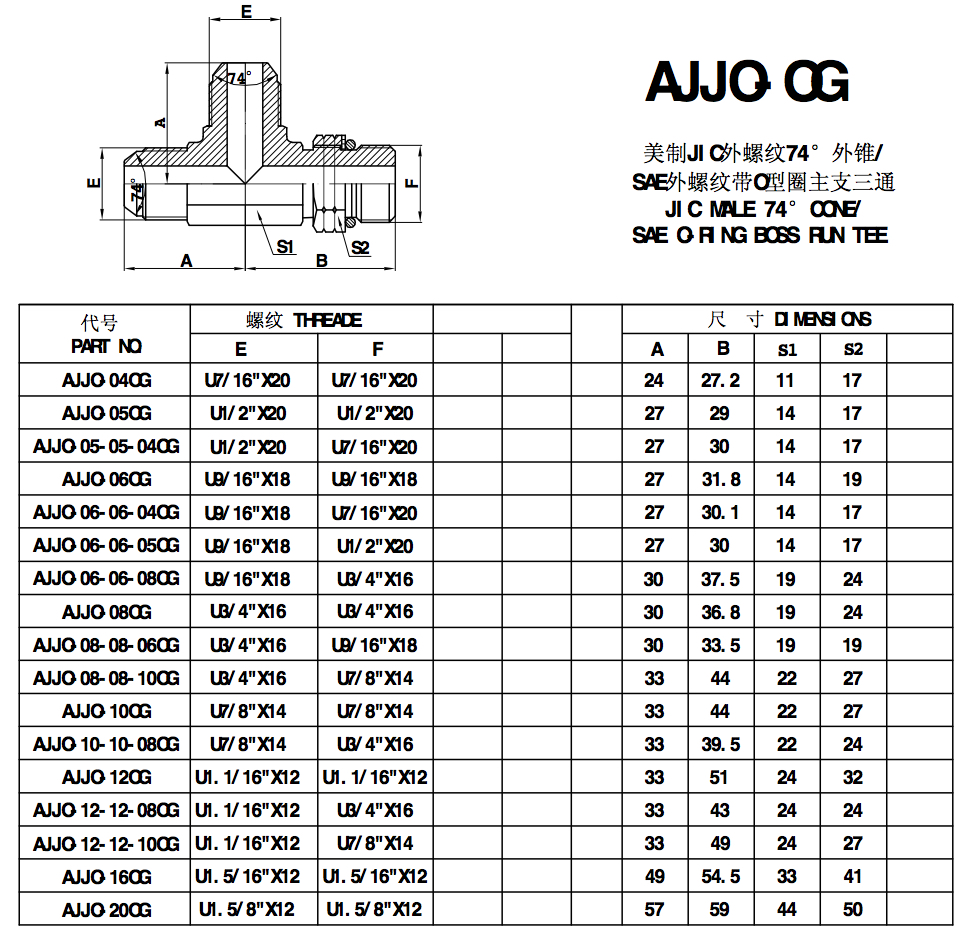
AJJO is the run tee. Two JIC male cone ends sit in line as the run. The third port, at 90 degrees between them, is an SAE O-ring boss. The run carries the flow. The branch carries whatever needs a face seal: a gauge line, a test point, a sensor block or a short feed to a manifold.
Both parts sit in the Ruihua Hardware adapter range under the same AJ code family, which is exactly why they get confused on a picking list.
The all-JIC tee: three cone ports, one part number per dash size.
Branch port differences that decide the stock slot
Point
AJ all-JIC tee
AJJO run tee
Run ports
Three cone ports
Two cone ports, in line
Branch port
37 degree cone
SAE O-ring boss
Seal on the branch
Metal to metal on a cone seat
O-ring compressed on a flat spotface
Adjustable after tightening
No
Yes, with a lockable mating part
Mating part
JIC female swivel or cone seat adapter
Port machined to SAE J1926-1
Typical job
Junction of three cone lines
Gauge, test point, sensor, manifold feed
The run tee: two cone ports in line, one O-ring boss branch at 90 degrees.
Check 1: Read the Branch Call-Out, Not the Photo
At arm's length the two parts look the same. Same tee body, same zinc-nickel finish, same hex. What you cannot see in a photo is the inside of the branch port, and that is the only thing that matters.
So take the call-out from the drawing or the bill of materials, and insist that it names the seal. "9/16-18 UNF" is a thread, not a call-out. "9/16-18 UNF JIC 37 degree" and "9/16-18 UNF SAE ORB to ISO 11926" are call-outs. When the sheet gives a thread size and nothing else, ask for the mating part number. It tells you the seal in one look, and it costs one email instead of one return.
Check 2: Compare the Thread With the Seal, Because Both Read the Same
This check decides most of the returns we see. JIC 37 degree and SAE O-ring boss share the same UNF threads per dash size: 7/16-20 at dash 04, 9/16-18 at dash 06, 3/4-16 at dash 08, 7/8-14 at dash 10, 1-1/16-12 at dash 12, 1-5/16-12 at dash 16.
A thread gauge cannot tell them apart. A caliper cannot either. What separates them is what happens after the thread engages. The cone joint seals metal to metal on a 37 degree seat, and the nut supplies the force. The O-ring boss seals on an O-ring compressed against a flat spotface, and the thread only holds it there.
Put an O-ring boss stud into a JIC female swivel and the thread runs all the way home with no seal at all. It feels correct. It holds on a cold pressure blip. It weeps once the oil warms up. That is why the stock list has to separate the two families even though they share a thread chart, a price band and often a bin.
Check 3: Price the Adapter You Would Have to Sell Instead
Skipping the run tee does not kill the sale. It converts the sale into two parts. The customer buys the all-JIC tee plus an adapter to reach the O-ring port, and both of you carry an extra part number anyway.
The honest comparison is not one part against two. It is two ports in one body against two parts screwed together. The screwed version adds a joint, adds a leak path and adds assembly time the customer pays for once per machine.
So push the question back to demand. If the branch only ever holds a gauge on a machine built twice a year, the adapter route is fine and the shelf slot is wasted. If the branch feeds a manifold or a sensor block ordered every month, the run tee pays for its slot in the first quarter. Ruihua Hardware prices both patterns on the same quote, so the comparison becomes a line item instead of a guess.
Check 4: Watch the Clocking Requirement
A cone joint seals at one angle. Once the nut is tight the branch points where it points, and turning it to clear a hose run means breaking the seal. An O-ring boss is different. The O-ring seals on a flat face, so the mating part can be turned to a working angle and then locked in place.
That freedom is why the run tee exists on real machines. Where the branch has to clear a frame rail, a filter housing or a bundle of hose, an O-ring branch plus an adjustable mating elbow solves a layout problem that a cone branch cannot. Ask one question before you commit the SKU: does this branch have to point somewhere specific? If yes, take the run tee. If it only has to connect, the all-JIC tee is cheaper and has fewer ways to go wrong.
At Ruihua Hardware both patterns are machined from the same C45 carbon steel bar stock and plated to the same 8 to 12 micron zinc-nickel specification, verified to 240 hours of ASTM B117. Surface finish is not a reason to choose one over the other.
Check 5: Size the Shelf by Dash, Not by Family
Both parts are priced and picked by dash size, and not every dash earns a slot. Two families across six dashes is twelve part numbers. Two families across the three dashes that actually move is six numbers and most of the revenue.
The stocking order is the same in every market we ship to. Put the all-JIC tee on the shelf first, across the dashes your customers already buy. Add the run tee only in the dashes where an O-ring branch shows up on a repeat order, which is usually the middle of the range. Ruihua Hardware quotes mixed pallets by dash size, so the slow dashes do not each carry a full carton.
Check 6: Label the Bin, Then Audit the Returns
Label rule: thread size first, seal second. "9/16-18 UNF — JIC 37 degree" on one bin, "9/16-18 UNF — SAE ORB, ISO 11926" on the next. A label that reads "9/16 tee" is an invitation to pick the wrong one, and the picker has no way to know.
Then audit. Split one quarter of returns into two buckets: wrong seal and wrong size. Wrong size is a picking problem you can fix with a count. Wrong seal is a bin layout problem, and it shows up as a cut or missing O-ring, or a cone face with a ring pressed into it. If that bucket is not empty, move the two bins apart before you order more stock.
Frequently Asked Questions
Can a run tee's O-ring branch take a JIC hose end when the threads match?
No. The thread engages and nothing seals. A JIC hose end carries a 37 degree cone and no O-ring, so it cannot seal against a flat spotface. The joint passes a static test at low pressure and weeps once the oil is warm.
Are run tee and branch tee the same part under two names?
Not in this range. The all-JIC tee has three cone ports and no dedicated branch. The run tee has two cone ports in line plus one O-ring boss branch at 90 degrees. Same body shape, different branch port, different mating part.
Which one should a distributor stock first?
The all-JIC tee, across the common dash sizes. It joins cone to cone with no adapter and covers the widest share of orders. Add the run tee where repeat orders show an O-ring branch.
Does an O-ring boss branch need a machined spotface?
Yes. SAE J1926-1 and its ISO 11926 equivalent define the spotface diameter and depth for each size. A tapped hole without the spotface will not seal, even with a new O-ring and correct torque.
Can both patterns be supplied in the same dash size?
Yes. AJ and AJJO are quoted in the same dash sizes off the same steel and plating route, so a trial order can put both on one machine and compare them under the same duty cycle.
Get One of Each and Compare Them on Your Own Bench
Send the branch port spec, the dash size and the mating part number, and the quote comes back with both patterns priced side by side so the choice sits on paper. Browse the adapter range on the products page, check the run tee data on the AJJO page and the all-JIC tee on the AJ page, then send the RFQ through the contact page. Ruihua Hardware answers with prices, plating options and lead times within one working day.
Lynn Liu is a Senior Foreign Trade Specialist at Ruihua Hardware with over 10 years of experience in hydraulic fittings export. She helps global buyers source reliable, cost-effective, and application-ready hydraulic connection solutions from China.