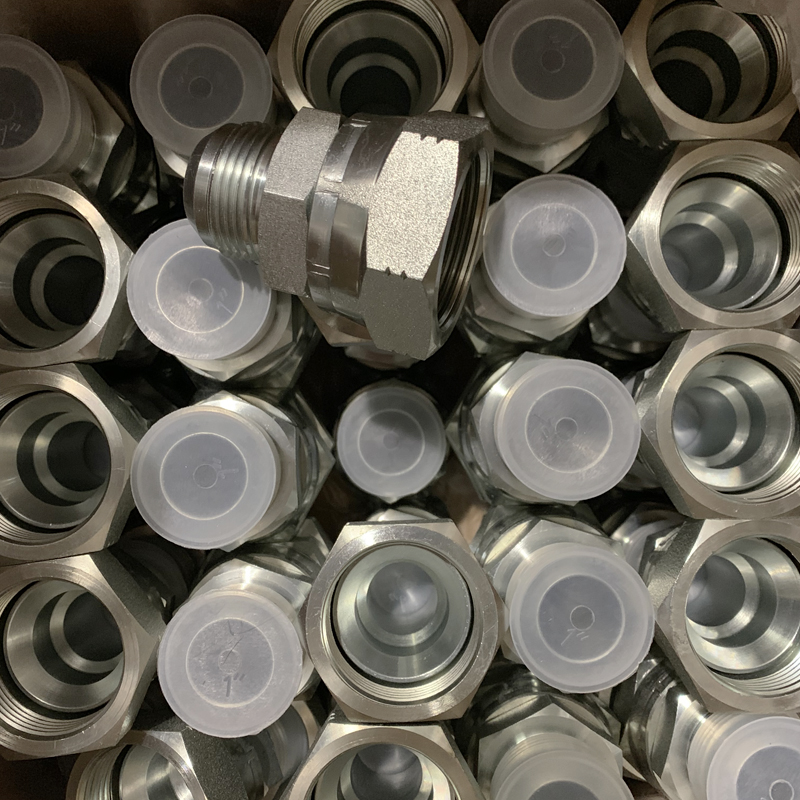
A distributor pulled a bin of adapters off the top rack, opened a poly bag, and found white powder on every hex flat. Four hundred zinc-plated fittings, five months in storage, one very unhappy customer — and a claim filed the same afternoon: "the plating is defective." The plating was not the problem. This is the post-mortem, and it is one every stock planner should read before the next humid season.
White rust on hydraulic fittings looks like a factory failure, because the parts were clean when they arrived and nobody touched them since. But zinc does something strange in a sealed bag: it corrodes itself on purpose, and a warehouse that traps condensation can exhaust that protection faster than a salt spray cabinet. Here is how the claim got settled, what the wipe test showed, and the five storage rules that keep the coating alive until the bin sells through.
The Claim: A Pallet of Adapters Came Back White
The setup is ordinary. A hydraulic distributor near a coastal port ordered a replenishment batch of zinc-plated JIC straight adapters in the common dash sizes. The goods arrived boxed, passed receiving without inspection beyond a count, and went onto steel racking — the top tier, under the roof deck, where the building heats up every afternoon. The poly bags inside the cartons were the loose, open kind. Stack heights were tight, pallet to pallet, shelf to shelf.
Five months of humid-season storage later, a customer pulled a bag, saw a dull white bloom across the hex flats and shoulders, and rejected the bin. The distributor checked three more bags from the same pallet. Same bloom. The claim went back up the chain with one line: plating defect, reject the batch, credit the account.
White Rust or Red Rust: The Wipe Test Decides
Before anything gets shipped, credited or scrapped, one ten-second test sorts the defect. Wipe the spot with a cloth and a little mineral spirits.
White or grey powder that wipes away, leaving a dull grey zinc surface underneath, is white rust — the corrosion product of the zinc layer itself, sometimes called wet storage stain. The coating is intact. Zinc is a sacrificial metal, and a thin deposit means it has been doing its job in damp air. Functionally, the fitting under that bloom is the same fitting that left the factory.
Red-brown film that will not wipe off, or rust bleeding out of small pits, is a different animal. That is the base steel corroding, which means the zinc layer has been breached at that spot. Pitting under the deposit, or corrosion creeping onto the thread flanks, moves the batch from cosmetic to structural — no distributor should sell it and no assembler should torque it.
When the claim amount justifies ten more minutes, put a coating thickness gauge on the wiped area and compare it to the batch certificate. The number either matches the plating spec, which closes the "defective coating" argument, or it does not, which starts a different conversation.
What the Returned Sample Showed the Factory
Three pieces came back with the claim, and they told a clean story. Ruihua Hardware re-measured the plating on the wiped flats: thickness within specification, matching the batch certificate. Fresh salt spray samples from the retained batch coupon held their standard result — the same zinc system with trivalent passivation that passes 96 hours of ASTM B117 before it ever gets boxed. The coating that arrived at the warehouse was the coating that left the plant.
That result moved the failure downstream, which is where almost all white rust claims land. A salt spray rating describes how long a coating survives a standardized, ventilated, drained cabinet test. It does not describe how the coating survives five months of condensation trapped between two nested steel surfaces with zero airflow. Those are different environments, and the second one is the warehouse's to control.
How Condensation Beats a Coating That Passes Salt Spray
The mechanism is worth understanding, because it explains why sealed packaging can make things worse, not better. Metal parts cool faster than the air around them. Every evening the roof deck above the top rack radiates heat out, the adapters on that rack cool below the dew point, and a film of moisture condenses on the zinc. Morning comes, the sun heats the building, the water evaporates. Repeat four hundred nights.
Where two plated surfaces touch — a bag of nested adapters, a tight stack, a bin packed shoulder to shoulder — the moisture wicks into the capillary gap and stays there for days. The zinc sacrifices itself inside that gap, and with no air circulation to dry it out, the deposit builds into the visible white bloom. An open shelf in the same room, with air moving over the parts, would show nothing. The coating did not get weaker; the storage microclimate got wetter than any test cabinet it was rated in.
The Bin Sort: Re-Oil, Re-Plate, or Scrap
With the mechanism settled, the four hundred adapters sorted into three grades in one afternoon. This is the decision table worth copying:
What the wipe test shows
Verdict
Action
Deposit wipes off, dull grey zinc underneath, no pitting
Cosmetic white rust, coating intact
Wipe, re-oil, repack with VCI in a sealed carton, ship
Deposit flakes, grey base metal shows in spots, threads clean
Coating locally exhausted
Re-plate the affected quantity or sell as seconds with disclosure
Red rust, pitting, or corrosion on threads or cone seat
Base steel corroded, joint integrity at risk
Scrap. Do not ship, do not credit to stock
The thread and seat rule is the one to enforce hardest. Corrosion on a hex flat is cosmetic; corrosion on a thread flank changes torque behavior, and corrosion inside a 24° cone seat or an O-ring groove is a leak waiting for its pressure test. In this claim, the bloom sat on the flats and shoulders, the threads stayed bright under their thread protect caps, and roughly ninety percent of the batch shipped again after a wipe and re-oil. The re-plate and scrap piles together accounted for the rest.
Five Storage Rules That Keep the Coating Alive
Nothing in the post-mortem requires new equipment. These five rules are the prevention half of the story:
Keep the factory packaging sealed, and add VCI paper for long holds. Factory cartons and bags are packed dry and counted to order. Decanting fittings into open bins starts the clock immediately. For anything held past a quarter, sealed cartons with VCI paper inside cost less than one claim.
Do not shrink-wrap tight stacks through a temperature swing. Wrapped pallets look tidy and behave like a condensation trap. Leave breathing room, keep racking away from the roof deck, and let air move over the cartons.
Store dry and off the floor. Away from doorways, dock aprons and damp exterior walls; on racking, not on concrete. A humidity reading in the aisle is a stock planner's cheapest insurance.
Run FIFO and match the plating to the holding horizon. Standard zinc with trivalent passivation carries roughly six to twelve months of sealed storage comfortably. For stock that needs to sit longer — or for coastal warehouses — the zinc-nickel system is the honest spec: it holds no red rust through 240 hours of ASTM B117, and Ruihua Hardware quotes it on parts like the 50011 standpipe for exactly that duty.
Keep the batch certificate and receiving photos with the bin. Plating spec, salt spray result, a photograph from arrival day, and dated storage notes settle the next claim in an email instead of an argument. Retaining the batch coupon at the factory end is the other half of that paper trail.
What a Stock Planner Asks About White Rust
Is white rust on new zinc-plated fittings a defect?
Not by itself. If the deposit wipes off and leaves dull grey zinc, the coating is intact and the fitting is functionally sound. Red rust, flaking deposits or pitting are the failing conditions. The cause in storage is almost always trapped condensation, not the plating line.
How do I tell white rust from red rust quickly?
Wipe it. White powder that comes off and leaves grey zinc is white rust — the coating still works. Red-brown film that stays, or rust out of pits, means base steel is corroding and the coating is breached. A thickness gauge against the batch certificate settles disputed cases.
Can fittings with white rust still be sold?
Light cases, yes — wipe, re-oil, repack with VCI, ship. Two things stop a sale: red rust anywhere, or corrosion on the threads or sealing surfaces, because both change how the joint torques and seals. Ruihua Hardware grades every disputed return against exactly that line before any credit discussion.
How long can zinc-plated fittings sit in storage?
Six to twelve months for standard zinc with passivation, sealed and dry. Zinc-nickel extends the horizon substantially. The calendar matters less than the conditions: sealed packaging, stable temperature, no condensation between nested parts.
What should I keep on file to settle a storage claim?
The batch certificate with the plating spec, a receiving photo from arrival day, and dated storage notes on packaging and humidity. With those three documents the claim resolves against the actual failure point — fast, and without the relationship damage that a blanket "defective plating" accusation costs.
Send the Storage Question With the Order
One habit prevents most of this: tell the supplier how long the stock will sit and where. If the honest answer is "eight months in a coastal warehouse," the coating conversation changes — standard zinc, zinc-nickel, or packaging with VCI from the start. Send it to Ruihua Hardware through the contact page and the quote comes back with the plating spec matched to the holding horizon. The full adapter range sits on the products page.
Two earlier articles cover the adjacent decisions. The piece on zinc-nickel versus zinc plating explains where the coating money goes; the salt spray acceptance guide shows how to read the 240-hour number on a quote before the goods ship. And if a customer's answer to white rust is "send me stainless instead," read why 316L does not automatically win first — storage stains are a warehouse problem, not a material problem, and stainless brings its own costs to the bin.
Lynn Liu is a Senior Foreign Trade Specialist at Ruihua Hardware with over 10 years of experience in hydraulic fittings export. She helps global buyers source reliable, cost-effective, and application-ready hydraulic connection solutions from China.